- Contract negotiation must happen with the employer. This ensures that unions will not be able to extort more than their labour is worth. At some point true business owner would prefer shutting his business down as an alternative to operating at a loss. Public unions, however, negotiate their contracts with other public workers in the government, while the true "business" owner - the taxpayer - is left out of the picture. This often allows public unions to negotiate conditions that could never be sustained in a profitable business.
- Business interests must be somewhat aligned with labour interests. The alignment does not have to be absolute. But if small private business goes bankrupt, workers normally suffer too. For public unions this is generally not so - public money comes in no matter what.
- Business must not be a monopoly. This is self-explanatory, I hope. The unwelcome effects of monopolies are well known in the Economic science. Healthy dose of competition ensures that labour stays aware of its true market price. Public unions are often operated within a monopoly service, such as school system, and the costs are frequently hidden from both the taxpayers and the users of these services. The results, again, are a distortion of the market and salaries that would never be obtained in a competitive business.
Showing posts with label politics. Show all posts
Showing posts with label politics. Show all posts
Tuesday, June 1, 2010
Good union, bad union.
A lot of discussion has been centered around excessive union demands that end up bankrupting various governments. Some have even declared all unions as evil. I think there can be a line drawn; some unions can be a useful tool of social equilibrium, while others may have no economic or social justification at all. I think private unions can be necessary to ensure that the profits are more fairly shared between the owners and the labour, but for this system to work, some conditions have to be met. Below I list those conditions and show how they often do not apply to public unions.

Monday, April 14, 2008
When policy-makers speak in an empty forest, do they make a sound?
This weekend we had a very fine illustration of an important truth: every word said by politicians and journalists is a lie more likely than not.
By all looks, it should have been very important: after all, G-7 summit itself spoke of potential currency intervention, asserted that it would not tolerate a weak dollar, and French Finance Minister Christine Lagarde even went as far as to call this a "turning point" and a major policy change.
Look, if this really was a policy change, and a turning point of some significance, then this is the kind of stuff which makes currency rates jump by 10% or more in day.
But in fact, after the announcement, dollar has done nothing but continue its usual fluctuations around the all-time low. This, of course, means that when politicians - even of the highest level - speak, no one thinks it is worth listening anymore.
Of course, the press either cannot comprehend or doesn't want to admit that market fluctuations are just that - random fluctuations. So, as usual, the press makes itself look clinically insane by simultaneously asserting that Dollar rebounds after G7 meeting and Dollar remains on backfoot after G7 meeting. Both articles are from the same newspaper (Forbes) and are published within 25 minutes of each other.
This whole farce underscores that the real reason for the credit crunch and liquidity problems is that lies and deceit are now in every part of the financial system. The reason Fed has been and remains so impotent in fighting the credit crunch, despite its unprecedented, almost trillion-dollar sized intervention, is that Fed's actions do nothing to restore the trust and honesty in the system. In fact, Fed's intervention has done nothing but help the banks further hide the truth. And as a result, it is doing nothing but prolong the crisis.
By all looks, it should have been very important: after all, G-7 summit itself spoke of potential currency intervention, asserted that it would not tolerate a weak dollar, and French Finance Minister Christine Lagarde even went as far as to call this a "turning point" and a major policy change.
Look, if this really was a policy change, and a turning point of some significance, then this is the kind of stuff which makes currency rates jump by 10% or more in day.
But in fact, after the announcement, dollar has done nothing but continue its usual fluctuations around the all-time low. This, of course, means that when politicians - even of the highest level - speak, no one thinks it is worth listening anymore.
Of course, the press either cannot comprehend or doesn't want to admit that market fluctuations are just that - random fluctuations. So, as usual, the press makes itself look clinically insane by simultaneously asserting that Dollar rebounds after G7 meeting and Dollar remains on backfoot after G7 meeting. Both articles are from the same newspaper (Forbes) and are published within 25 minutes of each other.
This whole farce underscores that the real reason for the credit crunch and liquidity problems is that lies and deceit are now in every part of the financial system. The reason Fed has been and remains so impotent in fighting the credit crunch, despite its unprecedented, almost trillion-dollar sized intervention, is that Fed's actions do nothing to restore the trust and honesty in the system. In fact, Fed's intervention has done nothing but help the banks further hide the truth. And as a result, it is doing nothing but prolong the crisis.
Saturday, March 22, 2008
Black Guy Asks Nation For Change.
Don't miss this funny Onion: Black Guy Asks Nation For Change.
But they don't even know what they have hit on!
A year from now, when a massive financial bailout has begun, come back and read this again.
But they don't even know what they have hit on!
A year from now, when a massive financial bailout has begun, come back and read this again.
Saturday, March 15, 2008
Look the other way!
So, more and more news are slowly coming out about Bear Sterns demise. Mostly it's the things you would expect, with Wall Street workers paralyzed with fear and uncertainty, Fed and other government officials running around with their hair on fire, etc.
Not interesting.
Looks like JPM is buying Bear after all - okay, saw that coming too. Fed must have offered some really sweet deal to JPM, maybe even full immunity to financial risks. Whatever.
Look the other way!
Not interesting.
Looks like JPM is buying Bear after all - okay, saw that coming too. Fed must have offered some really sweet deal to JPM, maybe even full immunity to financial risks. Whatever.
Look the other way!
While Wall Street was getting a heart attack, I was intently watching the news for any sign of Chinese involvement. They are the guys with $1.6 trillion dollars. They can just make the whole thing go away. The crisis has been raging for 6 months now, yet Chinese did nothing!
If they are going to help at all, now is the time. And then I saw this piece:
This is it, folks. I guess China is not helping. The only conclusion I can draw from this is that China must have realized that this crisis may effectively eliminate USA as a super-power, and they are letting it burn.
Remember that China is practically the last big player who is still propping up our terminally ill dollar. If China goes from 'not helping' mode into 'let's nudge them closer to the edge' mode, the whole effing game is over. Instantly.
Be. Very. Scared.
If they are going to help at all, now is the time. And then I saw this piece:
Citic Securities Co., China's largest brokerage by market value, said the company ``can't guarantee'' that it will reach a final agreement on a proposed investment in Bear Stearns Cos.
This is it, folks. I guess China is not helping. The only conclusion I can draw from this is that China must have realized that this crisis may effectively eliminate USA as a super-power, and they are letting it burn.
Remember that China is practically the last big player who is still propping up our terminally ill dollar. If China goes from 'not helping' mode into 'let's nudge them closer to the edge' mode, the whole effing game is over. Instantly.
Be. Very. Scared.
Thursday, March 13, 2008
Particle Physicist elected to Congress.
Maybe they do elect smart people sometimes! New congressman from Illinois is a former Particle Physicist Bill Foster who worked at Fermilab for a few years. Although I do not know Bill Foster personally, I have myself contributed many years of work to Fermilab. Fermilab recently ran into serious funding trouble so having a Congressman on its side will hopefully help.
Sunday, March 9, 2008
YAICHS: Yet Another Income's Correlation to Happiness Study.
Worldwide, Residents of Richer Nations More Satisfied
The above links to a yet another study which explores possible connection between wealth and happiness - by comparing various countries. Like most studies, the statistical analysis is completely flawed and conclusions blatantly wrong - I will address this in a second. The reason I think it is worth seeing is because their entire study is cutely summarized in a single picture:

To anyone educated in statistics this will look like a plot showing strong correlation between variables. However, after looking closely at this plot for a minute or two, I reach a different conclusion. This plot, in fact, appears to be composed mostly of two distinct parts.
First part is countries where incomes are more or less zero. Not surprisingly, happiness is low there - people are dying in wars and starving. But even there, there is a large spread in reported happiness, for basically the same level of income. I would bet this is due to presence or absence of war in a respective country.
Second part of the plot is all the countries where incomes are non-zero, above 2000$ per year or so. There, the variations in reported happiness are so huge, any correlation is nearly meaningless. But if you look even closer, you will see that almost every country that is at the lower end of the happiness spectrum, regardless of income, is either a country where there is a war, social injustice, or despotic oppressive regime. So GDP per capita may look okay, but if a large fraction of population is either left to starve, or is being tortured and imprisoned, or lives in a war zone, you would expect happiness to decline.
So, as is so typical of social studies, the results are misunderstood in this one. And as usual, the pseudo-scientists forgot to estimate what the uncertainty is and what is the statistical significance of their conclusions (it is very small). While the study shows correlation of happiness and income, it doesn't interpret it correctly. To me, it looks like the study demonstrates that happiness is negatively affected when people's right to live is endangered, either through war, or economical or political persecution. That GDP is also correlated with personal freedom and peace, is a secondary affect here. Once someone has bread, warmth and freedom, all correlation between income and happiness almost disappears. The reason we see correlation in the plot is because countries where people are more equal, more free and more peaceful, are usually way more productive.
So what we have here is yet another 'scientific' study that made a classical mistake of confusing correlation with causation. The real cause of rising happiness is less threatening situation in a given country, which correlates with GDP per capita.
The above links to a yet another study which explores possible connection between wealth and happiness - by comparing various countries. Like most studies, the statistical analysis is completely flawed and conclusions blatantly wrong - I will address this in a second. The reason I think it is worth seeing is because their entire study is cutely summarized in a single picture:
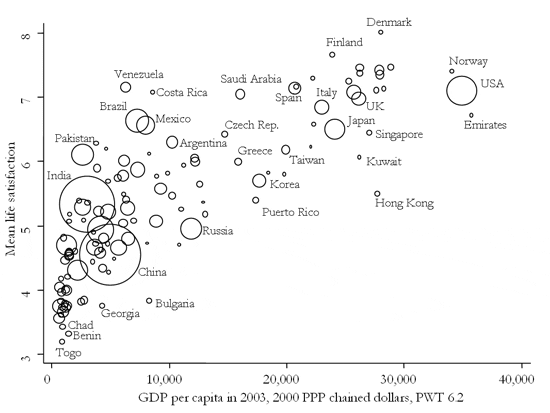
To anyone educated in statistics this will look like a plot showing strong correlation between variables. However, after looking closely at this plot for a minute or two, I reach a different conclusion. This plot, in fact, appears to be composed mostly of two distinct parts.
First part is countries where incomes are more or less zero. Not surprisingly, happiness is low there - people are dying in wars and starving. But even there, there is a large spread in reported happiness, for basically the same level of income. I would bet this is due to presence or absence of war in a respective country.
Second part of the plot is all the countries where incomes are non-zero, above 2000$ per year or so. There, the variations in reported happiness are so huge, any correlation is nearly meaningless. But if you look even closer, you will see that almost every country that is at the lower end of the happiness spectrum, regardless of income, is either a country where there is a war, social injustice, or despotic oppressive regime. So GDP per capita may look okay, but if a large fraction of population is either left to starve, or is being tortured and imprisoned, or lives in a war zone, you would expect happiness to decline.
So, as is so typical of social studies, the results are misunderstood in this one. And as usual, the pseudo-scientists forgot to estimate what the uncertainty is and what is the statistical significance of their conclusions (it is very small). While the study shows correlation of happiness and income, it doesn't interpret it correctly. To me, it looks like the study demonstrates that happiness is negatively affected when people's right to live is endangered, either through war, or economical or political persecution. That GDP is also correlated with personal freedom and peace, is a secondary affect here. Once someone has bread, warmth and freedom, all correlation between income and happiness almost disappears. The reason we see correlation in the plot is because countries where people are more equal, more free and more peaceful, are usually way more productive.
So what we have here is yet another 'scientific' study that made a classical mistake of confusing correlation with causation. The real cause of rising happiness is less threatening situation in a given country, which correlates with GDP per capita.
Wednesday, March 5, 2008
Republicans not letting Democrats have a democratic vote.
Holding a fair democratic election is not an easy thing to achieve. But I have long suspected that the convoluted election process in USA is purposefully complex and full of little rules and exceptions here and there. After all, the harder it is to understand the process, the easier it is to manipulate by those in the know, so I get that.
I have a PhD myself and still it took me over an hour to understand how primaries work (even without all these niceties in rules). Only to realize that at the end of the day, 200 people in Washington (super-delegates) have about as much electoral power as 20 million "ordinary" people.
But has USA finally reached the point where the system is so ridiculous it stopped bearing any semblance to democracy? Here is the latest example which makes me inclined to think yes.
Clinton and Obama were close in primary race, with Obama having somewhat better momentum. A lot depended on Texas and Ohio primaries, where Obama win would seal his nomination and would let him start preparing to the actual presidential election. I believe odds were placed in his favor, too. Republican race was finished at that point, with McCain already having won his nomination.
Seems like a fairly innocent setup, but here is where all the little complexities arise: Ohio and Texas allow open primaries, i.e. anyone can come and vote, without registering with a party. And what happened is that a lot of republicans (who did not need to vote for McCain anymore) went to the democratic poll booth and voted as if they were democrats. They voted for the candidate who was behind (Clinton in this case) to make sure democrats continue to squabble, throw dirt at each other, and waste money, while McCain is gathering money and momentum.
So, what kind of election is that where a republican can come to a democratic primary and just mess with the results? What kind of vote is that where many people have incentive to vote for the 'bad' candidate, just to weaken the candidate they themselves consider 'strong'?
I have a PhD myself and still it took me over an hour to understand how primaries work (even without all these niceties in rules). Only to realize that at the end of the day, 200 people in Washington (super-delegates) have about as much electoral power as 20 million "ordinary" people.
But has USA finally reached the point where the system is so ridiculous it stopped bearing any semblance to democracy? Here is the latest example which makes me inclined to think yes.
Clinton and Obama were close in primary race, with Obama having somewhat better momentum. A lot depended on Texas and Ohio primaries, where Obama win would seal his nomination and would let him start preparing to the actual presidential election. I believe odds were placed in his favor, too. Republican race was finished at that point, with McCain already having won his nomination.
Seems like a fairly innocent setup, but here is where all the little complexities arise: Ohio and Texas allow open primaries, i.e. anyone can come and vote, without registering with a party. And what happened is that a lot of republicans (who did not need to vote for McCain anymore) went to the democratic poll booth and voted as if they were democrats. They voted for the candidate who was behind (Clinton in this case) to make sure democrats continue to squabble, throw dirt at each other, and waste money, while McCain is gathering money and momentum.
So, what kind of election is that where a republican can come to a democratic primary and just mess with the results? What kind of vote is that where many people have incentive to vote for the 'bad' candidate, just to weaken the candidate they themselves consider 'strong'?
Thursday, February 7, 2008
Great quote on democracy and fiscal policy.
"A democracy cannot exist as a permanent form of government. It can only exist until the voters discover that they can vote themselves largesse (generous gifts) from the public treasury. From that moment on the majority always votes for the candidates promising the most benefits from the public treasury, with the result that a democracy always collapses over loose fiscal policy (which is) always followed by a dictatorship."
"The average age of the world's greatest civilization has been two hundred years. These nations have progressed through this sequence. From bondage to spiritual faith; from spiritual faith to great courage; from courage to liberty; from liberty to abundance, from abundance to complacency; from complacency to apathy, from apathy to dependence, from dependence back into bondage."
-- Alexander Tyler circa 1787 , from "The fall of the Athenian Republic".
This certainly seems to describe well the recent trajectory of the USA's economical-political concoction. People voted en mass for GWB's tax cuts and it did not bother them one bit that spending was not cut simultaneously. Nor did they care that every serious economist was saying that "trickle-down economy" does not work.
As a result, huge imbalances in the financial system have built up, and they will now have to unwind with a lot of pain for the US and world economies. Perhaps this has already started, and the financial crisis that gripped the country recently is the first step in the great correction. At the end of this correction, the US political and economical position in the world will likely be much weaker than today.
I guess the lesson here is that if country wants to be a workable democracy it has to be mindful of the quote above. Tyler is not necessarily correct - I believe democracy can be stable over a long term. But to achieve that you have to have to work on educating people, and by that I don't just mean teaching them technical skills, but teaching them to think critically about everything and giving them a broad basic knowledge base.
In general, I believe that a better educated population is capable of maintaining a higher order social structure. If more people were able to understand the very basic economic principles related to the proposed tax cuts, we may not have landed ourselves into a financial mess which can only end badly...
P.S. I found that quote on the forums at Calculated Risk - a great blog on housing and broader economy.
UPDATE: 03/11/08
Anonymous reader was kind enough to point out that the quote may have been faked. However, even if the author of the quote is unknown, I still find the observation to be interesting - history has many examples of voters irresponsibly voting in favor of give-aways.
"The average age of the world's greatest civilization has been two hundred years. These nations have progressed through this sequence. From bondage to spiritual faith; from spiritual faith to great courage; from courage to liberty; from liberty to abundance, from abundance to complacency; from complacency to apathy, from apathy to dependence, from dependence back into bondage."
-- Alexander Tyler circa 1787 , from "The fall of the Athenian Republic".
This certainly seems to describe well the recent trajectory of the USA's economical-political concoction. People voted en mass for GWB's tax cuts and it did not bother them one bit that spending was not cut simultaneously. Nor did they care that every serious economist was saying that "trickle-down economy" does not work.
As a result, huge imbalances in the financial system have built up, and they will now have to unwind with a lot of pain for the US and world economies. Perhaps this has already started, and the financial crisis that gripped the country recently is the first step in the great correction. At the end of this correction, the US political and economical position in the world will likely be much weaker than today.
I guess the lesson here is that if country wants to be a workable democracy it has to be mindful of the quote above. Tyler is not necessarily correct - I believe democracy can be stable over a long term. But to achieve that you have to have to work on educating people, and by that I don't just mean teaching them technical skills, but teaching them to think critically about everything and giving them a broad basic knowledge base.
In general, I believe that a better educated population is capable of maintaining a higher order social structure. If more people were able to understand the very basic economic principles related to the proposed tax cuts, we may not have landed ourselves into a financial mess which can only end badly...
P.S. I found that quote on the forums at Calculated Risk - a great blog on housing and broader economy.
UPDATE: 03/11/08
Anonymous reader was kind enough to point out that the quote may have been faked. However, even if the author of the quote is unknown, I still find the observation to be interesting - history has many examples of voters irresponsibly voting in favor of give-aways.
Tuesday, January 15, 2008
More about Social Security Trust Fund.
My previous post about SS fund being whole was a little misleading. It was interpreted by some people as meaning that "there is no problem, nobody panic". But the correct interpretation should be slightly different. What the analysis done by Bruce Webb shows is that the trust fund has enough assets in it right now to remain whole indefinitely if those assets remain at their expected values. The catch here is that fund's assets are mostly invested in US government bonds rather than in cash. In other words, US government borrowed money from the Social Security Trust Fund. The Fund therefore has direct exposure to US debts, and therein lies the problem. While US government debt is still (officially) AAA-rated, some economists have argued that US has amassed such a huge debt burden that it cannot possibly repay it in a normal way, so some kind of default has to happen. Since outright default of the government (like in Russia or Argentina) is unlikely, debt will be dealt with in a combination of other ways. Some of it will be devalued through inflation and dollar devaluation, some may be paid off through tax increases, and some through budget cuts. None of these three ways alone will be sufficient to deal with the debt. For example, if US lets inflation climb too high, it will devalue some debt that is sitting in things like non-inflation-indexed 10 and 30 years bonds but it will only make harder to pay other debts, such as the ones in short-term bonds that are getting rolled over and on which the interest rates would climb very high. Tax increases are very unpopular and extreme (read impossible) hikes would be needed to fix the budgets. Therefore the most likely course of action by the government would be to slash the spending, and some of the biggest items in the budget are Social Security and Medicare. Essentially, government may have to cut pensions to pay off the debts.
And this is the real threat to Social Security, not the lack of assets in the Trust Fund. The source of the problem is in the unbalanced federal budgets, not the Social Security structure. The reason we hear so much talk in the media about Social Security being broke is twofold. First, politicians want people to start getting used to the idea that Social Security is not guaranteed and will be scaled down. It is much easier to negotiate pension payments down if you can make people believe that they should expect no pension at all. The second reason is that government tries to divert people's attention from the real problem. If people understood that the root of the problem is in unbalanced budgets, not in Social Security itself, they would demand that budgets are cut by reducing things like military spending, and politicians don't want to hear that. It seems safer to convince people that their pensions are slashed because the Social Security system was broken rather than tell them that it's because the money was spent fighting a set of unpopular wars.
So no, Social Security is not broken. The government spending habits are.
And this is the real threat to Social Security, not the lack of assets in the Trust Fund. The source of the problem is in the unbalanced federal budgets, not the Social Security structure. The reason we hear so much talk in the media about Social Security being broke is twofold. First, politicians want people to start getting used to the idea that Social Security is not guaranteed and will be scaled down. It is much easier to negotiate pension payments down if you can make people believe that they should expect no pension at all. The second reason is that government tries to divert people's attention from the real problem. If people understood that the root of the problem is in unbalanced budgets, not in Social Security itself, they would demand that budgets are cut by reducing things like military spending, and politicians don't want to hear that. It seems safer to convince people that their pensions are slashed because the Social Security system was broken rather than tell them that it's because the money was spent fighting a set of unpopular wars.
So no, Social Security is not broken. The government spending habits are.
Thursday, January 3, 2008
Social Security may not be broke.
I am sure you have all heard the story before: Social Security is so unprepared to deal with its future liabilities that it is completely broke for all practical purposes. Well, one person decided to sit down and actually do the numbers on his own, and documented the calculations in his blog. His conclusion? Social Security is not broke. The blog makes for a fun read for the number crunchers among us.
Subscribe to:
Posts (Atom)

 Posts
Posts


