We have long assumed that we understood the invigorating effect of caffeine. But based on a new study, it looks like habitual drinkers develop tolerance to the stimulating powers of coffee, just like they develop tolerance to dehydrating effects of caffeine. The real reason coffee addicts feel "woken up" by a cup of coffee is because they were feeling withdrawal symptoms (like all other addicts do!). Drinking coffee brings them back to normal, which of course feels like a major improvement from the distressed state they were in before.
So only first-time coffee drinkers get the real cognitive boost, while regular drinkers show improved performance simply by alleviating the addiction withdrawal. Very interesting perspective.
Here is a link to Science Daily article on this: Coffee consumption unrelated to alertness: Stimulating effects may be illusion, study finds.
Showing posts with label science. Show all posts
Showing posts with label science. Show all posts
Thursday, June 3, 2010

Thursday, March 18, 2010
So can we make it official that there is a LOT of bad science out there?
Something that I have been noticed many years ago when I tried looking at some papers on the social and medical studies is that very frequently they perform statistical analysis incorrectly, and draw conclusions unsupported by their own data.
Well I just found a great article which not only fully describes this problem, but gives a lot more additional insight to offer: Odds Are, Its Wrong.
Choice quote from the article:
Let it be noted, however, that statistical analysis is usually done much more rigorously and soundly in fields like Physics and Chemistry. But it is only achieved by vigilance of the reviewers and constant emphasis on that fact that evaluating the uncertainties in your research is much more important that the actual result. I remember that on almost every paper I worked on, 80% of the total research time was spent analyzing the probabilities of your results being wrong.
Well I just found a great article which not only fully describes this problem, but gives a lot more additional insight to offer: Odds Are, Its Wrong.
Choice quote from the article:
In fact, if you believe what you read in the scientific literature, you shouldn’t believe what you read in the scientific literature.“There is increasing concern,” declared epidemiologist John Ioannidis in a highly cited 2005 paper in PLoS Medicine, “that in modern research, false findings may be the majority or even the vast majority of published research claims.”Ioannidis claimed to prove that more than half of published findings are false, but his analysis came under fire for statistical shortcomings of its own.Now when I want to explain people why I don't believe the results of most recent medical studies, I will just give them this link!
Let it be noted, however, that statistical analysis is usually done much more rigorously and soundly in fields like Physics and Chemistry. But it is only achieved by vigilance of the reviewers and constant emphasis on that fact that evaluating the uncertainties in your research is much more important that the actual result. I remember that on almost every paper I worked on, 80% of the total research time was spent analyzing the probabilities of your results being wrong.
Monday, February 9, 2009
From bad science department: environmental impact of walking.
I often lament the lack of common sense in many scientists. Today's exhibit is going to be about a crazy piece of research which was even enthusiastically discussed by Freakonomics blog in Be Green: Drive followed up by More Analysis of the Environmental Impact of Walking vs. Driving. The researchers tried to calculate the carbon footprint of walking 1.5 miles versus driving 1.5 miles. Depending on how bad your diet is, walking could generate more carbon. One author then even went as far as recommend driving instead as more environment friendly.
Let me make a few observation which firmly put all of that research into mad science department.
Let me make a few observation which firmly put all of that research into mad science department.
- Worrying about the carbon footprint of human metabolism is silly for two reasons. First, unless you want to consider killing humans, we cannot do much about metabolism itself. It continues even while we sleep. Second, this carbon footprint comes mostly from food production, so we should work on making food production cleaner, not stop walking around, as the paper seems to suggest.
- Among those who try to achieve a greener lifestyle, walking is not considered an alternative to driving. Environmentally friendly alternatives to driving are living closer to work, taking commuter trains and using bicycles (which are 3-5 times more efficient than walking).
- People need exercise to stay healthy. That's why people should take a walk instead of driving (that, and fresh air).
- Even if all of us walk all day long, we will only increase the pollution levels by a minuscule amount.
Thursday, March 13, 2008
Particle Physicist elected to Congress.
Maybe they do elect smart people sometimes! New congressman from Illinois is a former Particle Physicist Bill Foster who worked at Fermilab for a few years. Although I do not know Bill Foster personally, I have myself contributed many years of work to Fermilab. Fermilab recently ran into serious funding trouble so having a Congressman on its side will hopefully help.
Sunday, March 9, 2008
YAICHS: Yet Another Income's Correlation to Happiness Study.
Worldwide, Residents of Richer Nations More Satisfied
The above links to a yet another study which explores possible connection between wealth and happiness - by comparing various countries. Like most studies, the statistical analysis is completely flawed and conclusions blatantly wrong - I will address this in a second. The reason I think it is worth seeing is because their entire study is cutely summarized in a single picture:

To anyone educated in statistics this will look like a plot showing strong correlation between variables. However, after looking closely at this plot for a minute or two, I reach a different conclusion. This plot, in fact, appears to be composed mostly of two distinct parts.
First part is countries where incomes are more or less zero. Not surprisingly, happiness is low there - people are dying in wars and starving. But even there, there is a large spread in reported happiness, for basically the same level of income. I would bet this is due to presence or absence of war in a respective country.
Second part of the plot is all the countries where incomes are non-zero, above 2000$ per year or so. There, the variations in reported happiness are so huge, any correlation is nearly meaningless. But if you look even closer, you will see that almost every country that is at the lower end of the happiness spectrum, regardless of income, is either a country where there is a war, social injustice, or despotic oppressive regime. So GDP per capita may look okay, but if a large fraction of population is either left to starve, or is being tortured and imprisoned, or lives in a war zone, you would expect happiness to decline.
So, as is so typical of social studies, the results are misunderstood in this one. And as usual, the pseudo-scientists forgot to estimate what the uncertainty is and what is the statistical significance of their conclusions (it is very small). While the study shows correlation of happiness and income, it doesn't interpret it correctly. To me, it looks like the study demonstrates that happiness is negatively affected when people's right to live is endangered, either through war, or economical or political persecution. That GDP is also correlated with personal freedom and peace, is a secondary affect here. Once someone has bread, warmth and freedom, all correlation between income and happiness almost disappears. The reason we see correlation in the plot is because countries where people are more equal, more free and more peaceful, are usually way more productive.
So what we have here is yet another 'scientific' study that made a classical mistake of confusing correlation with causation. The real cause of rising happiness is less threatening situation in a given country, which correlates with GDP per capita.
The above links to a yet another study which explores possible connection between wealth and happiness - by comparing various countries. Like most studies, the statistical analysis is completely flawed and conclusions blatantly wrong - I will address this in a second. The reason I think it is worth seeing is because their entire study is cutely summarized in a single picture:
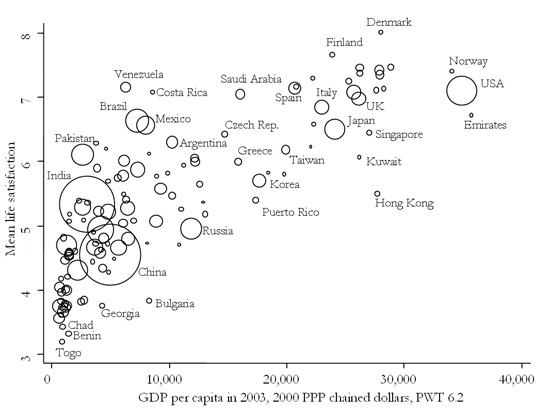
To anyone educated in statistics this will look like a plot showing strong correlation between variables. However, after looking closely at this plot for a minute or two, I reach a different conclusion. This plot, in fact, appears to be composed mostly of two distinct parts.
First part is countries where incomes are more or less zero. Not surprisingly, happiness is low there - people are dying in wars and starving. But even there, there is a large spread in reported happiness, for basically the same level of income. I would bet this is due to presence or absence of war in a respective country.
Second part of the plot is all the countries where incomes are non-zero, above 2000$ per year or so. There, the variations in reported happiness are so huge, any correlation is nearly meaningless. But if you look even closer, you will see that almost every country that is at the lower end of the happiness spectrum, regardless of income, is either a country where there is a war, social injustice, or despotic oppressive regime. So GDP per capita may look okay, but if a large fraction of population is either left to starve, or is being tortured and imprisoned, or lives in a war zone, you would expect happiness to decline.
So, as is so typical of social studies, the results are misunderstood in this one. And as usual, the pseudo-scientists forgot to estimate what the uncertainty is and what is the statistical significance of their conclusions (it is very small). While the study shows correlation of happiness and income, it doesn't interpret it correctly. To me, it looks like the study demonstrates that happiness is negatively affected when people's right to live is endangered, either through war, or economical or political persecution. That GDP is also correlated with personal freedom and peace, is a secondary affect here. Once someone has bread, warmth and freedom, all correlation between income and happiness almost disappears. The reason we see correlation in the plot is because countries where people are more equal, more free and more peaceful, are usually way more productive.
So what we have here is yet another 'scientific' study that made a classical mistake of confusing correlation with causation. The real cause of rising happiness is less threatening situation in a given country, which correlates with GDP per capita.
Saturday, January 5, 2008
Why good scientists should do bad science.
After reading about yet another speculation about nature of the Universe on Slashdot, I decided it was time to organize my thoughts on the matter a bit. This particular Slashdot article was about a scientific paper that asserts the need for scientists to seriously consider an idea that our Universe is someone's virtual reality (VR) simulation (so called VR world hypothesis). This was noticed by Internet community and a lengthy discussion followed on New Scientist and from there on Slashdot. Interestingly enough, the paper was submitted as Computer Science one, but maybe more appropriate topic would be Philosophy or Physics. In fact, here is another paper on a similar topic (and it is much more thought through), but this one is more appropriately marked as Physics.
The predictable reactions ranged from "Who cares, it's impossible to prove or disprove", to "This is pseudo-science, these people are bad scientists and should be ashamed". I think both statements are wrong and too many take them for granted.
The predictable reactions ranged from "Who cares, it's impossible to prove or disprove", to "This is pseudo-science, these people are bad scientists and should be ashamed". I think both statements are wrong and too many take them for granted.
Let me start by admitting that currently theories like VR world are not scientific. But that is simply because science is usually defined as "things that could be subjected to scientific method". Just because right now we can't think of any experiments to test these theories or any new predictions that these theories make does not mean we never will. Science is full of examples when seemingly simple problems could not be solved for centuries and I am sure many felt tempted to say that "maybe these problems can never be solved" only to be proven wrong. So to me it seems like thinking about currently unscientific models and trying to bring them into the realm of science is something scientists should do, and it should be respectable work. Working on such seemingly absurd topics does not make you a bad scientist, only a courageous one; you would only be a bad scientist if you were spitting out propaganda and claimed that these theories are scientific and plausible now.
Also, think about this: people who go around saying "all such theories can never be proved or disproved" are themselves making a statement which is not known to be either true or false, and trying to make it sound like it is a logically sound statement. To me they do qualify as bad scientists, spreading a false claim. Until somebody conclusively and logically proves that all the non-traditional theories about the nature of the Universe are not verifiable, I will continue to put these people in the same bucket as religious zealots banning evolution in schools. The only theories which cannot be proved or disproved are the ones which were never formulated: for example, nobody ever defined what God is or supposed to be, so we got nothing to work with if we want to prove God's existence. But once you formulate a theory (like: world if VR) you are in a completely different realm.
In conclusion: it is a respectable effort for scientists to think about issues related to the nature of the Universe and try to build a bridge between alternative theories (like VR world) and today's science. The fact that such theories are not science today does not mean they can not become science tomorrow.
It seems especially ironic that alternative theories continue to get ridiculed by 'science' zealots while in the meantime humans themselves have come very close to building an artificial universe. If we can already build a rat's brain cell replica inside a computer, how far away can we be from building an exact copy of human brain, except represented as a computer program? How hard would it be then to feed this 'software brain' with whatever inputs we want and make it believe it lives in a world we simulate? So maybe instead of ridiculing Matrix-like theories of the Universe, we should realize we are about to create such "matrices" for others - so time has come to start thinking how would we test our own environment for being Matrix-like.
Finally, there is a direct connection between such efforts and religion. If ever we are able to find strong confirmation for one of the alternative theories of the Universe, it could simultaneously confirm and overthrow the belief in the existence of God. For example, if we discovered that our entire Universe is just a computer simulation run by some other beings, it would confirm many things that religions taught us about the world (such as an Act of Creation or presence of some ultimate all-powerful being) but it seems to me that such a revelation would nevertheless be considered a disastrous blow by many who believe in God.
Subscribe to:
Posts (Atom)

 Posts
Posts


